
As a combustion engine lover, I have to some degree bemoaned the march toward electric motorcycles. It’s not that I am against electricity, it is simply that I would rather have some form of combustion engine if the pollution that is created isn’t significant. Towards that objective, there have been two alternate schools of thought, one European primarily, and the other Japanese.
Both two very different approaches to finding a solution that will enable all of us who love ‘engines’ in the strictest form of the word are being refined by the two camps of engineers and scientists hard at work. Each group has been involved in this journey of discovery for many years with the primarily German and Italian scientists focused on SYNGAS technologies. This technology essentially creates a synthetic fuel that oxidizes the fuel more efficiently leaving small amounts of greenhouse-creating gases within its exhaust. The two players in this field are BMW and Ducati.
The other route to get to zero emissions is being made by a consortium of Japanese manufacturers headed by the big four players in motorcycle production, that being Honda, Kawasaki, Suzuki, and Yamaha. Within this group, scientists have been working on a Hydrogen solution, in concert with Toyota. Honda and Suzuki lead the hydrogen approach, and Honda has partnered with General Motors subsidiary Isuzu to develop a next-generation fuel cell system for a truck, due in 2027.
The ‘Big Four’ have pooled their resources to develop what is called the ‘hydrogen small mobility engines’ group. The group acronym is HySE. The most astounding outcome of this technology is the fact that almost all of the exhaust is made up entirely of harmless water vapor. What I think most of us will love is that these engines will essentially be the same as petrol-powered four-stroke engines, but turbo or supercharging combined with direct fuel injection will be vital.
Petrol engines need an air/fuel mixture of 14.7:1, whereas hydrogen engines will run on a 34:1 air/fuel ratio and can run at up to 180:1. The higher ratios will help ensure that these engines run clean. Simply put, this means that hydrogen is nearly three times as power-dense as petrol. You require much more air in the cylinder to get equivalent performance. Supercharging can overcome this problem.
Hydrogen Fuel Cells
Hydrogen-powered combustion engines convert fuel and air directly into motion and heat and don’t require an electric motor to accomplish this. The internal components are similar to combustion engines, so the supply chain is not disrupted. They can also run on hydrogen that isn’t pure. There is, however, a downside, as they are less efficient. Somewhere in the range of 40 to 45 is turned into power, whereas fuel cells can be 60% efficient. They also emit some NOx, oxides of Nitrogen, which is an air pollutant.
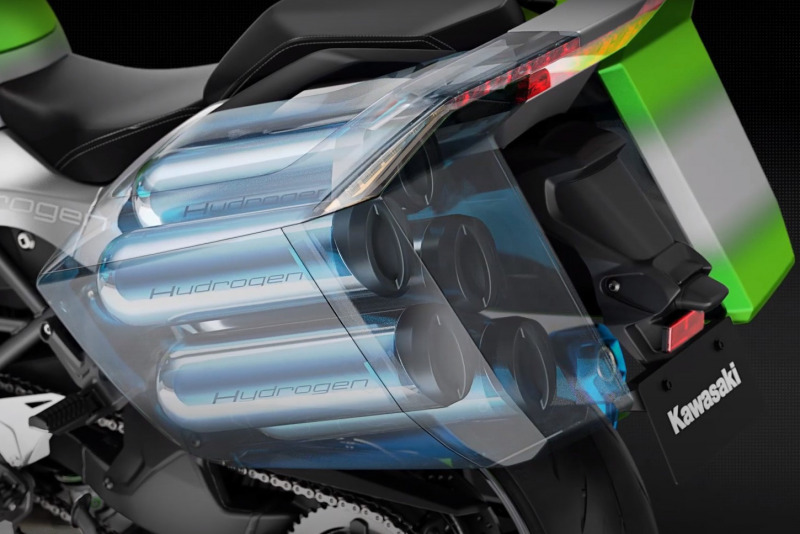
One of the significant problems, however, is the fuel storage ‘size’. Panniers would have to be replaced with fuel storage cells, so bike storage for touring then becomes a constraint. However, this problem is being addressed and the final arrangement of fuel storage is yet to be determined.
Whichever system is finally adopted, most motorcycle ‘purists’ will probably want to opt for either the SYNGAS or Hydrogen solution. Other problems still exist in that the infrastructure for both types of fuels is not yet in place. Bosch is, however, committed to hydrogen fuels and plans to have 4000 filling stations in place by 2025. Stay tuned and thanks for coming.
In short, electric motorcycles may fall victim to newer technologies and to buyers’ dislike for an electric answer. Motorcyclists appear to prefer an ‘engine’ variant versus an electrical solution.
Thanks to MCN for the information, Kawasaki for the photo, BMW, Ducati, Bosch, Honda, Suzuki, and Yamaha as well as General Motors and Isuzu for their specific fuel information as well. It is appreciated.

Leave a Reply