

Last fall I took a Yamaha Tracer 9 GT+ for a test ride. While I was impressed with the motorcycle, as many reviews have been, the price of $21,764 CDN is $6000.00 more than my Kawasaki Ninja 1000sx. Having ridden both machines, I still prefer my Kawasaki. Let’s have a closer look at the 2024 GT+.

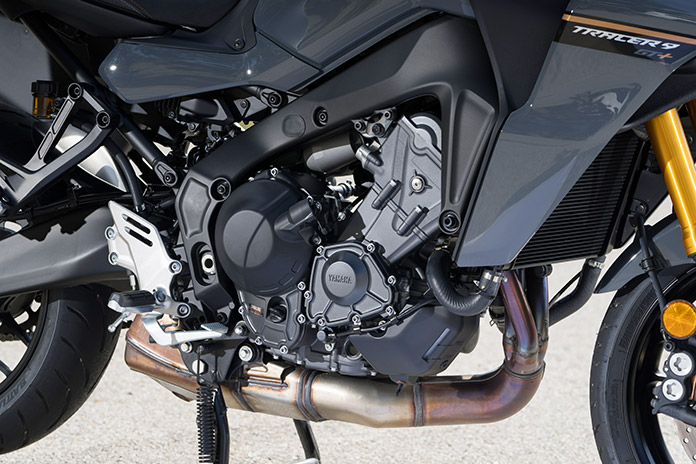
The Yamaha 890cc CP3 inline-Triple produces 108 hp at 10,000 rpm and 63 lb-ft of torque at 7,200 rpm. While full of character, it is the addition of a couple of technologies to the bike that for some, seems to be important. Personally, I am not in favor of intrusive electronics and dial down or off those intrusions on the inertial measurement unit (IMU) of my Ninja.

While I only rode the bike for an hour putting on about 50 miles, I think it gave me some insights into how well the bike handled, accelerated, stopped and its level of comfort. The big news from Yamaha for the Tracer 9 GT+ is adaptive cruise control or (ACC). It utilizes a millimeter-wave (mmWave) radar system that emits short-wavelength electromagnetic wave signals that are reflected by objects in their path, allowing the system to determine the distance and velocity of these objects. Once the system detects a vehicle ahead in the same lane, if the vehicle is travelling at a slower speed, the motorcycle will slow to match the lead vehicles speed and maintain a set distance. The rider can adjust the distance with a trigger on the left grip to a range between one second of following distance, to four seconds.
Personally, I wouldn’t find the feature useful. I do not like automatic intervention, and prefer to not have my speed reduced automatically by the motorcycle. Usually, depending on the situation, I would simply pass the lead vehicle and resume my cruise control speed if I’m on an interstate highway. Combined with the unified braking system (UBS), which is the second technological advance found on the Yamaha, the ability of the system to balance braking by both the front and rear brakes aids in controlled stops where sudden deceleration would be a problem and the likelihood of a panic stop may see a rider lock-up his front brake. On the Yamaha, the IMU also inputs suspension control adjusting the suspension’s compression damping to prevent chassis pitch. One advantage is that the rear disc on the Yamaha has increased to 267mm in size along with having made the rear brake pedal wider with a more beveled shape.
I have used a similar linked braking system on my Honda VFR, (though without the automatic aids) and I would rather modulate the brakes myself. This feature may well be helpful to a new rider, and I suppose that’s where the appeal is best made.
Other features of the GT 9+ have improved from my very first ride on the 2021 version of the GT. First, the replacement of the pair of TFT displays into a new 7 inch display with new switchgear is welcomed. I was not in favor of the former twin screens. Combined with bluetooth connectivity through Yamaha’s MyLink app, it allows text messages and incoming messages to be displayed on the dash. Weather and info alerts as well as Garmin’s Motorize navigation function are useful additions but require a subscription and add to the cost.

Riding the Tracer is quite enjoyable. The engine is responsive but requires keeping the revs high to get the most from the powerplant. The Tracer has upright riding position like an adventure tourer, providing slightly less lean than my Ninja 1000sx. Combined with its wide handlebars that offer more than adequate steering leverage, the bike is quite agile. The brakes are strong and responsive providing good feedback and the chassis seems quite firm, responding well to imputs.
The adjustable screen and handguards provide good wind protection, something I would have liked on my Ninja. I found the seat on my Ninja better than on the Tracer, however to be fair I was not on the bike long enoungh for a true test of its comfort.

The Tracer has a slightly better range than my Ninja 1000sx, proving about 230 miles of range, (200 for my Ninja) and it is sixteen pounds lighter overall, however, the additional 34 horsepower of my Kawasaki more than makes up for the additional weight. I simply prefer more horsepower.
I suppose for owners, it depends on how much value one places on the new technologies found on the Tracer GT+. For me, personally, I would rather do what I have done and pay $15,000 for my discounted Kawasaki Ninja 1000sx, having the additional horsepower, extra cylinder and acceleration. Add to that an additional year of warranty in Canada, and it pretty much sealed the deal.

But is the Yamaha a great sports-tourer? Undoubtedly. It really depends on what one wants from their chosen motorcycle. Each has its benefits, price being the final big consideration for me. If I had deeper pockets though, it likely would not have swayed my decision as the new rider aids don’t really matter to me.
Yamaha makes great motorcycles, of that there is no argument. Someone other than me may well have gone the other way and made the opposite choice. To each his own. No matter which choice one makes in the Sport-Tourer category, you won’t find a lemon in the bunch. Motorcycles keep getting better and for us, collectively, it’s a fantastic time to ride.
Thanks to ridermagazine.com for the photos and their review as well.
https://ridermagazine.com/wp-content/uploads/2023/08/Yamaha-Tracer-9-GT-10.jpg
Ciao…
Leave a Reply