
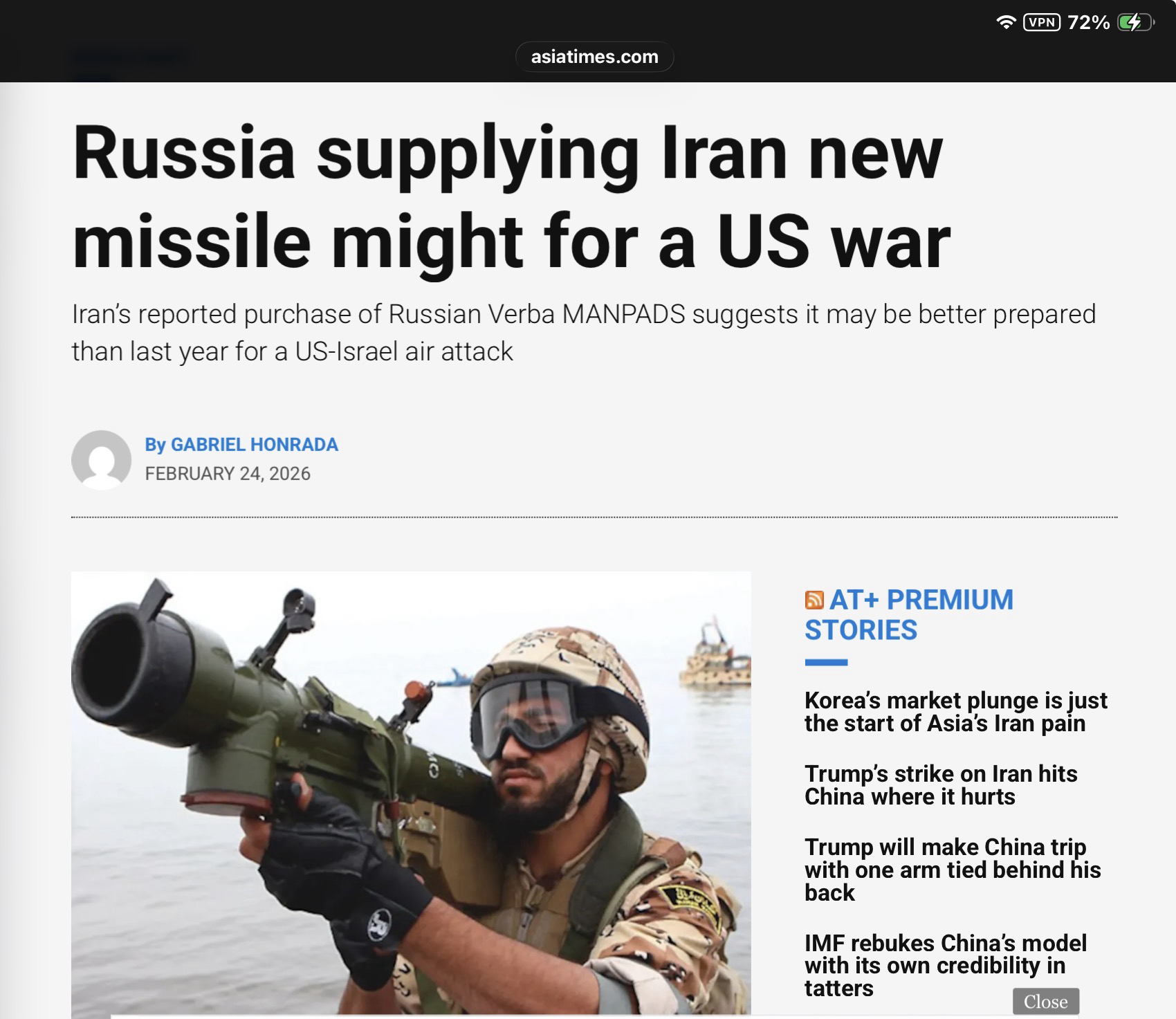
Would Russia Provide Iran with Hypersonic Missiles for Defence and might it have already?
Political Editorial Opinion
Iran May be Better Equipped With Sophisticated Undefendable Russian Missiles Than We Think
Over the past two years, Russia has received significant military supplies via the Caspian Sea, – from Iran. Notably, in early 2023, Russian cargo ships transported over 300,000 artillery shells and 1 million rounds of ammunition from Iran to Russia. Additionally, in September 2024, Iran delivered over 200 Fath-360 short-range ballistic missiles to Russia via the Caspian Sea. These shipments have been crucial in supporting Russia’s military operations, particularly in Ukraine. Chat GPT, March 9th, 2026 8:35 pm
The Caspian Sea is a landlocked body of water that connects five nations that all border its shores, including Russia, Turkmenistan, Azerbaijan, Kazakhstan, and Iran.
As none of these nations are members of the NATO alliance, the transshipment of weapons systems and munitions occurs without any policing or intervention, as the five nations only exercise control within their territorial waters of 15 kilometres offshore.
And since it is a landlocked Sea (saltwater, not fresh water), it is not considered International waters (or a Lake). Each nation on the Caspian Sea has a small naval component that ensures navigation in the sea, except for Azerbaijan, which maintains 260 ships and a fleet of (24) large and fairly capable ships in the Caspian Sea.
The rest of the Caspian Sea is open navigable waters subject to transit for commercial and military ships alike.
Which Begs the Question – Is Russia Supplying or, likely to Supply Iran with Sophisticated Military Equipment for Use Against the U.S. and Israel via the Caspian Sea?
Over the last four years, Iran has shipped over 1 million rounds of ammunition to Russia and 300,000 rounds of artillery munitions for use in Ukraine.
The two countries are now ‘partners’ in relation to the war against Ukraine and support each others military forces as well as providing strategic information, including satellite imagery for surveillance and reconnaissance as to the disposition of Ukrainian, and now American assets, their strength and disposition surrounding Iran.
Russia’s latest Hypersonic missiles could pose a massive risk to U.S. ships in the straight of Hormuz, the Red Sea or the Indian Ocean if these weapons were provided by Russia to its ‘strategic partner’ Iran, now at war with the United States of America. The question is, — is the Tsirkon now ‘land deployable?’

Russia’s Volga-Don Canal can only handle ships of up to about 5000 tonnes, due to the restricted lock sizes, which means that usually freighters carrying supplies, and increasingly munitions and weaponry, sail from Bandar-Anjali a large northern commercial port on the Caspian Sea to Astrakhan in Russia at the mouth of the Volga River and canal system.
These ships are more than capable of carrying sophisticated missiles, including the Tsirkon hypersonic missile, whether they were to be shipped via the Baltic through the canal or directly from Russian ports on the Caspian Sea.
Iran’s Deylaman Stealth Destroyer is the most capable and modern ship in the Caspian Sea as seen below, capable of intercepting aircraft entering the Caspian Sea.

It would appear that currently, the United States has not struck any of Iran’s ships in the Caspian Sea, as it has no naval assets within the Caspian Sea, however, should it decide to, these ships would be within striking distance from American carriers operating against Iran currently.
By comparison, Azerbaijan’s largest frigate in the Caspian Sea is the Gusar (G-121), a former Soviet Project 159A SKR-16 Bakinetz-class frigate commissioned in 1967. This 81.8-metre vessel has a displacement of approximately 950 tonnes and is armed with two twin 76mm cannons and four RBU-6000 anti-submarine rocket launchers, along with three 533mm torpedo tubes. Stationed in Baku, it serves as the flagship of the Azerbaijani Navy, which operates a fleet of 24 vessels, including four submarines, one frigate, and various patrol and mine warfare ships.
However, striking Russian ships, including container ships transiting the Caspian Sea would be an act of war that obviously Azerbaijan would not want to take part in.
Which begs another question.
An important consideration by the United States, is what level of risk is it willing to pursue in relation to regime change in Iran?
If the Dog of War, Petey Boy Hegseth is told by his King to continue to goad Iran into the use of such weapons, assuming that Russia would be willing to provide or has provided them to Iran, — he may find that a major capital ship of immense power, containing 75 state of the art stealth fighters could lie at the bottom of a large body of water off Iran at some point while he’s ‘fist bumping his compatriots on FOX TV.’
Such a skilled tactician and strategist, that boy, is not.
The Art of Collateral Damage
Starting a war is easy. Really easy. America has been maintaining one almost continually since 1953.
So it’s good to hear that the current Precedent, Mango Mango Man, is dedicated to ending all wars, right?
Oh…right. Nine air attacks in less than a year, huh?
Well, they weren’t really war-like attacks were they? Besides.. war is hell, — so says Donnie Boy. He’s never actually fought in one or even taken off his slippers in anger, but he knows, because Rear Guard Hegseth showed him some pictures of it in the Oval Office while he was watching it all happen from the rear.
The hard part in war is stomaching the massive number of civilian deaths and the long-term effects of unintended consequences. This can certainly lead to elevating your enemy’s response to the point of existential threat.
And while Iran, doesn’t have that ability yet (or does it?), if America invades Iran, I wouldn’t put money on what it is willing to do?
If China invaded California, do you think America might use a nuclear response? Of course not? Right? Right?
Because when a bully gets to the point where he’s ready to seriously hurt his opponent, and the little guy discovers his foot can reach the bully’s gonads faster than he can respond?
That’s what a hypersonic missile represents.
Leave a Reply